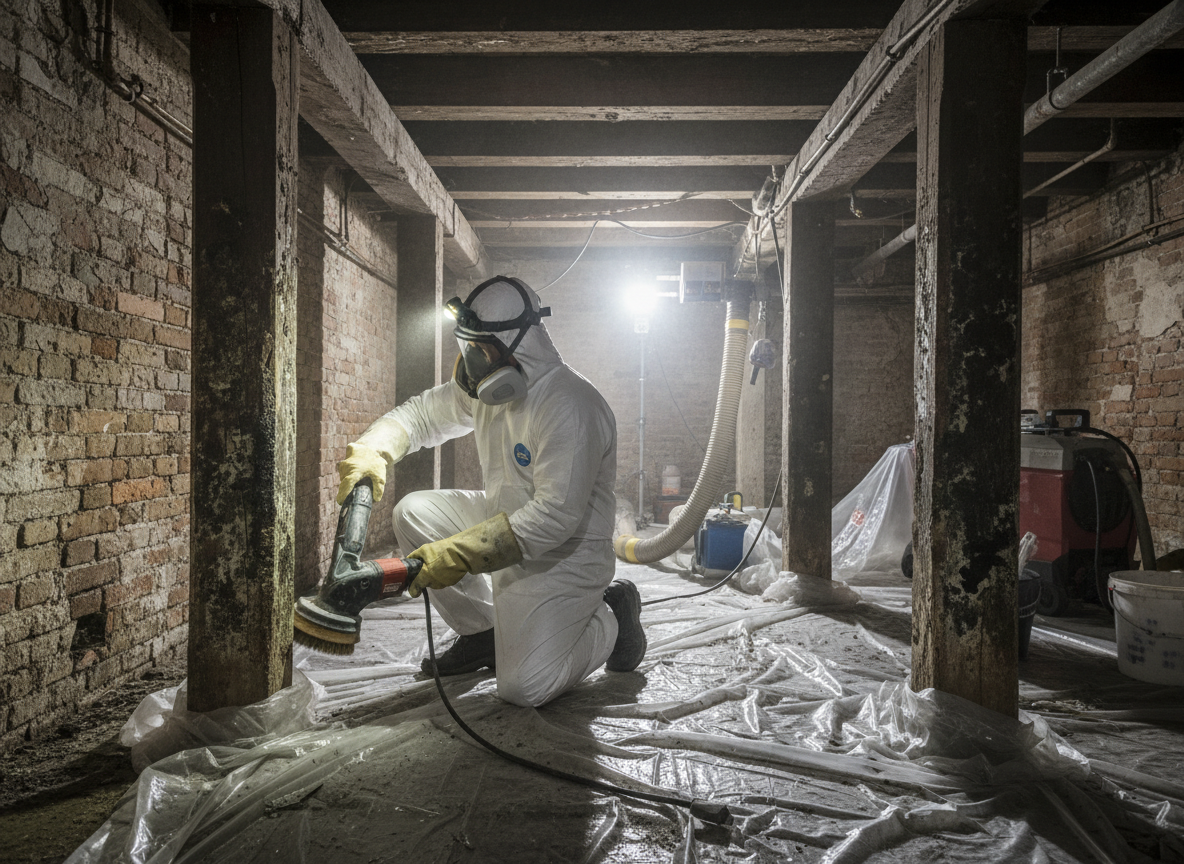
Venice properties built before the 1960s often sit on raised foundations with shallow crawl spaces that trap humidity from the nearby Pacific and the Venice Canals. Mild Mediterranean winters keep soil damp year-round, allowing mold to spread across joists and insulation once a pipe leak or poor drainage introduces extra moisture. Technicians must work around tight clearances and older knob-and-tube wiring while containing spores before they reach living areas above.
Removal starts with negative-air machines exhausting through exterior vents rather than into the street or neighboring lots on Abbot Kinney Boulevard. Affected fiberglass batts and particleboard are bagged on site, followed by HEPA vacuuming of subfloor sheathing and application of antimicrobial coatings rated for enclosed spaces. In Oakwood bungalows, crews frequently discover mold extending into wall cavities where the crawl meets the stem wall, requiring additional access cuts that homeowners rarely anticipate.
Post-remediation, dehumidifiers run until wood moisture content drops below 12 percent, then vapor barriers and sealed crawl vents are installed to limit future condensation. Los Angeles County building codes require proper permits when structural wood is affected, so documentation of pre- and post-work moisture readings is provided for any future sale or insurance claim.
Nearby Santa Monica and Marina del Rey homes share similar sandy soils that drain quickly yet retain enough salt air to corrode metal fasteners, so replacement hardware is often stainless. Rose Avenue properties with added square footage over original crawl spaces create dead-air pockets that need separate treatment zones to avoid cross-contamination.
Technician insight
In Venice, the thing that catches most people out with crawl space mold removal is how quickly salt air and canal seepage keep wood damp even after a small leak is fixed; older Oakwood homes with dirt floors and no original vents need the entire perimeter sealed or the mold returns within a season.
Oakwood Bungalow Crawl Space
Homeowner noticed musty odor after winter rains near the Venice Canals. Inspection found black mold on joists from a slow sewer cleanout leak and missing vapor barrier. Crew contained the space, removed insulation and affected wood sections, dried the area, and installed a sealed liner with new vents. Odor cleared and moisture readings stayed under 12 percent on follow-up.
How it works
- 1
Initial Assessment
Technicians enter the crawl space from Venice homes to map moisture sources, measure wood moisture, and identify mold growth extent without disturbing spores.
- 2
Containment Setup
Plastic sheeting and negative air machines isolate the work area so spores do not migrate into living spaces above or onto nearby sidewalks like the Venice Beach Boardwalk.
- 3
Material Removal
Contaminated insulation, wood, and debris are cut out, double-bagged, and removed through exterior access points while HEPA filtration runs continuously.
- 4
Drying and Treatment
Air movers and dehumidifiers bring moisture levels down, followed by EPA-registered antimicrobial application on remaining structural members.
- 5
Prevention Install
New vapor barrier, sealed vents, and drainage corrections are added to limit recurrence in the mild but persistently humid Venice climate.
Pricing
Project cost depends on crawl space size, depth of mold into framing, and any required structural repairs; 24/7 dispatch available from the Abbot Kinney address.